
Man-ime: Joseph Joestar — The Resourceful Rebel: Intelligence, Humor, and Courage

Updated: 1 hour ago
By Mike Viscusi | Simple Gaijin
What can the second JoJo teach us about intelligence, adaptability, humor, courage, and the difference between being clever and becoming a responsible man?
Series: JoJo's Bizarre Adventure: Battle Tendency (ジョジョの奇妙な冒険 戦闘潮流)
Original publication: 1987–1989
Creator: Hirohiko Araki (荒木飛呂彦)
Character: Joseph Joestar (ジョセフ・ジョースター)
Historical setting: 1938–1939, primarily the United States and Europe
Martial art: Hamon / Ripple (波紋)
Masculine ideal: The resourceful rebel
A Gentleman Who Doesn't Believe in Fighting Fair
Imagine being the grandson of a man celebrated for his courage, kindness, honor, and gentlemanly conduct. Your grandfather believed that a respectable man should confront danger with dignity, treat others honorably, and refuse to compromise his principles. His extraordinary strength was matched by an equally extraordinary sense of responsibility.
Now imagine inheriting that legacy while possessing almost none of his refined manners. You're loud, sarcastic, impulsive, and perfectly willing to lie, cheat, or run away if doing so gives you an advantage. You don't particularly care whether your opponents consider you honorable, provided you can defeat them and survive.
This is the personality of Joseph Joestar, the second major protagonist of Hirohiko Araki's JoJo's Bizarre Adventure. Introduced in Battle Tendency, Joseph is a young American-raised Englishman whose unconventional fighting style stands in sharp contrast to the traditional gentlemanly ideals of his grandfather, Jonathan Joestar. Rather than confronting enemies through straightforward displays of strength, Joseph prefers psychological manipulation, improvisation, and elaborate tricks.
Yet beneath his obnoxious personality lies a man capable of extraordinary courage, compassion, and loyalty. Joseph repeatedly risks his life to protect others, develops meaningful friendships, and demonstrates that intelligence can overcome seemingly insurmountable physical disadvantages. His personality raises an important question about masculinity: does a man need to behave honorably at all times, or can unconventional methods serve honorable purposes?
Joseph's story also forces us to confront a more uncomfortable distinction. Being clever enough to overcome an enemy doesn't necessarily mean possessing the wisdom to make responsible decisions in everyday life. His extraordinary victories and personal shortcomings make him one of the most complicated masculine role models in the Joestar family.
Who Is Joseph Joestar?
Joseph Joestar is the grandson of Jonathan Joestar and Erina Pendleton, whose story formed the foundation of Phantom Blood. Born in 1920, Joseph grows up under the care of his grandmother Erina and maintains a close relationship with Robert E. O. Speedwagon, one of Jonathan's most devoted companions. Unlike his grandfather, Joseph has a rebellious personality and frequently gets himself into trouble through his quick temper and disrespect for authority.
By the events of Battle Tendency, Joseph possesses extraordinary physical abilities and a natural talent for Hamon, the supernatural breathing technique once practiced by Jonathan. However, he initially lacks the discipline and formal instruction necessary to use that ability to its full potential. Instead, Joseph relies on his remarkable observational skills, unconventional thinking, and talent for anticipating an opponent's behavior.
His adventures eventually bring him into conflict with the Pillar Men, ancient beings possessing extraordinary strength, intelligence, and supernatural abilities. These opponents are considerably more powerful than ordinary human beings, making conventional combat exceptionally dangerous. Joseph must therefore develop his abilities while learning how to outmaneuver enemies who appear almost impossible to defeat.
Although Joseph becomes a formidable fighter, his greatest strength remains his ingenuity. He constantly evaluates his surroundings, searches for weaknesses, and attempts to turn an opponent's advantages against them. His methods may lack the dignity associated with traditional martial arts, but they frequently produce results.
Joseph's personality also remains important throughout his later appearances in Stardust Crusaders and Diamond Is Unbreakable. As he grows older, he becomes a father, grandfather, and eventually a man forced to confront the consequences of choices made outside the battlefield. These later developments allow us to examine whether his intelligence and courage translate into genuine personal maturity.
Jonathan and Joseph: Two Different Definitions of Masculinity
To understand Joseph's character, we should begin by comparing him with his grandfather. Jonathan Joestar represents a traditional understanding of gentlemanly masculinity built around courtesy, honor, courage, humility, and personal integrity. He believes that the manner in which a man conducts himself is just as important as the objectives he pursues.
Joseph approaches the world very differently. He rarely concerns himself with appearing respectable, and he is perfectly willing to use deception or unconventional tactics when confronting a dangerous enemy. Where Jonathan might regard fair combat as an expression of honor, Joseph considers fighting fairly against a superior opponent unnecessarily foolish.
This distinction is important because traditional masculine ideals sometimes place excessive emphasis on appearances and rigid expectations. A man may feel compelled to confront every challenge directly because retreating or changing tactics might damage his reputation. Joseph challenges this mindset by demonstrating that there are circumstances in which adaptability matters more than maintaining a particular image.
Nevertheless, Joseph's approach is not automatically superior to Jonathan's. His willingness to manipulate opponents is understandable when innocent lives are threatened, but the same behavior becomes questionable when used for personal convenience. The ability to deceive another person doesn't necessarily establish that doing so is morally justified.
Despite their differences, Jonathan and Joseph share several important qualities. Both possess considerable courage, demonstrate loyalty toward their companions, and refuse to tolerate deliberate cruelty toward innocent people. Their personalities may be dramatically different, but the moral convictions underlying their most admirable actions remain recognizable.
Together, these two generations of the Joestar family demonstrate that masculinity doesn't have to follow a single personality type. A man can be serious or humorous, conventional or rebellious, physically imposing or intellectually resourceful. What ultimately matters is whether his behavior reflects courage, responsibility, compassion, and genuine consideration for others.
Intelligence: Joseph's Greatest Weapon
One of Joseph's most recognizable habits involves predicting exactly what an opponent is about to say. This seemingly ridiculous technique demonstrates his remarkable ability to observe behavior, recognize patterns, and anticipate reactions. By announcing an opponent's next words before they speak, Joseph frequently unsettles them and gains a psychological advantage.

His intelligence extends far beyond this entertaining party trick. Joseph constantly searches for ways to manipulate his surroundings, exploit an enemy's assumptions, and transform seemingly useless objects into effective weapons. He understands that physical strength becomes considerably less important when someone can dictate the circumstances of a confrontation.
This approach proves especially valuable against the Pillar Men. Santana, Esidisi, Wamuu, and Kars possess abilities that make them overwhelmingly dangerous opponents. Joseph cannot simply overpower them through brute force, so he must identify weaknesses and develop strategies that compensate for his physical disadvantages.
Joseph's ingenuity offers an alternative to the traditional association between masculinity and physical dominance. A man who relies exclusively on strength may find himself helpless when faced with problems that cannot be solved through confrontation. Intelligence allows him to evaluate circumstances, recognize opportunities, and develop solutions that would otherwise remain unavailable.
However, intelligence also creates responsibilities. Joseph's cleverness occasionally encourages him to believe that he can escape virtually any predicament, regardless of how recklessly he behaves. His confidence sometimes becomes arrogance, particularly when he assumes that his natural abilities eliminate the need for careful preparation.
There is an important difference between being intelligent and exercising good judgment. Intelligence allows someone to recognize possibilities, while wisdom involves understanding which possibilities are worth pursuing. Joseph demonstrates considerable talent for the former, but his development throughout the series reveals that the latter requires additional maturity.
The Art of Running Away: Cowardice or Common Sense?
Perhaps Joseph's most unconventional characteristic is his willingness to retreat when facing overwhelming danger. Unlike traditional action protagonists who insist on confronting every opponent directly, Joseph recognizes that running away can sometimes be the most practical response. He frequently uses retreat as an opportunity to reconsider his strategy, manipulate the environment, or create a more favorable situation.
This challenges a longstanding expectation associated with traditional masculinity. Men are sometimes encouraged to believe that backing down automatically demonstrates cowardice, regardless of the circumstances. Such thinking can encourage unnecessary confrontations in which preserving one's pride becomes more important than protecting one's life.
Joseph approaches the problem from a different perspective. If remaining in a particular situation guarantees defeat, withdrawing may preserve the opportunity to respond more effectively later. His retreats frequently serve a larger strategic purpose rather than representing an unwillingness to confront danger.
However, there is a meaningful distinction between strategic retreat and abandoning responsibility. A man who withdraws to protect others, gather information, or avoid unnecessary violence may be exercising sound judgment. Someone who repeatedly escapes difficult obligations simply because they are uncomfortable is demonstrating a very different attitude.
Joseph's behavior illustrates both sides of this distinction. His willingness to escape hopeless confrontations often demonstrates remarkable practicality, but his impatience and impulsiveness can also make him reluctant to address unpleasant responsibilities. His example reminds us that retreat is neither inherently courageous nor inherently cowardly.
The important question is why someone chooses to withdraw. Courage doesn't require participating in every conflict, and responsibility doesn't always require standing one's ground. Sometimes the most admirable decision is recognizing that a particular battle simply isn't worth fighting.
Robert E. O. Speedwagon: Preserving the Joestar Legacy
Robert E. O. Speedwagon occupies a particularly important position in Joseph's life because of his friendship with Jonathan Joestar. Originally a criminal who encountered Jonathan on Ogre Street, Speedwagon eventually became one of his closest companions and most devoted supporters. By the events of Battle Tendency, he has become a wealthy industrialist and founded the Speedwagon Foundation.
Speedwagon's devotion to the Joestar family continues long after Jonathan's death. He maintains close ties with Erina and helps preserve the legacy of the man whose kindness changed his life. His relationship with Joseph provides a connection between two generations of the family.
This is significant because Joseph grows up without knowing his grandfather personally. He inherits a reputation for courage and honor, but his understanding of that legacy must come through the people who remember Jonathan. Speedwagon serves as one of the living examples of the loyalty and friendship Jonathan inspired.
Joseph's relationship with Speedwagon also reminds us that masculinity can involve maintaining commitments across generations. Speedwagon's devotion isn't based on financial obligation or personal advantage, but on the genuine gratitude he feels toward someone who treated him with dignity. His continued involvement with the Joestar family demonstrates that meaningful friendships can create responsibilities extending far beyond the original relationship.
For Joseph, Speedwagon represents an important form of continuity. The younger Joestar may reject many of his grandfather's traditional manners, but he remains surrounded by people whose lives were transformed by Jonathan's character. This connection helps explain why Joseph's unconventional personality still exists within a family tradition rooted in compassion and loyalty.
Caesar Zeppeli: Brotherhood Beyond Pride

Joseph's relationship with Caesar Anthonio Zeppeli provides one of the most important examinations of male friendship in Battle Tendency. Caesar is the grandson of William Anthonio Zeppeli, the Hamon master who sacrificed himself while assisting Jonathan Joestar. Proud, disciplined, and deeply conscious of his family's history, Caesar approaches his responsibilities with a seriousness that Joseph initially finds irritating.
Their contrasting personalities lead to frequent arguments and competitive behavior. Joseph mocks Caesar's refined mannerisms and apparent arrogance, while Caesar criticizes Joseph's lack of discipline and disrespectful attitude. Neither man initially seems particularly interested in acknowledging the other's strengths.
However, their rivalry gradually develops into genuine friendship. Caesar learns to recognize Joseph's intelligence and remarkable instincts, while Joseph develops an appreciation for Caesar's determination and commitment to his family's honor. Their differences become opportunities for mutual growth rather than permanent obstacles to cooperation.
This relationship demonstrates that brotherhood doesn't require complete agreement or identical personalities. Men can challenge one another, disagree about important matters, and possess radically different approaches to life while still developing meaningful friendships. What matters is whether their competition eventually produces respect rather than resentment.

Caesar's death during his confrontation with Wamuu becomes one of the most devastating moments in Joseph's life. Despite their previous disagreements, Joseph is overwhelmed by grief when he learns that his friend has been killed. His normally playful personality gives way to an unmistakable expression of sorrow.
This moment reveals an important aspect of Joseph's character. Beneath the sarcasm, theatrical confidence, and constant jokes is a young man who genuinely values his relationships. His willingness to grieve openly demonstrates that emotional attachment doesn't diminish masculine courage.
Nevertheless, Caesar's death also raises difficult questions about pride and responsibility. His decision to pursue a dangerous confrontation independently reflects courage and devotion, but it also exposes the risks of allowing personal determination to override practical judgment. Joseph's grief reminds us that loyalty should involve protecting friends from unnecessary danger, not merely celebrating their willingness to sacrifice themselves.
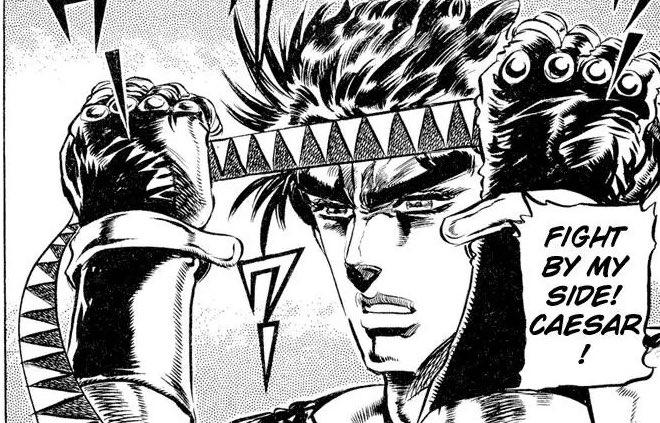
Lisa Lisa: Discipline, Humility, and the Willingness to Learn
Joseph's natural abilities make him remarkably effective in dangerous situations, but they also contribute to his lack of discipline. He frequently relies on instinct and improvisation rather than sustained training, and his early successes encourage the belief that cleverness can compensate for almost any weakness. His encounter with Lisa Lisa forces him to reconsider that assumption.

Lisa Lisa is an accomplished Hamon master whose extraordinary knowledge and abilities exceed those of her younger students. She subjects Joseph and Caesar to demanding training designed to develop their control, endurance, and understanding of Hamon. Her instruction leaves little room for laziness or attempts to avoid difficult work.
Joseph initially resists her strict methods, but he gradually recognizes that his natural talent is insufficient for the challenges ahead. His progress depends on accepting instruction from someone who understands the martial art far better than he does. This willingness to learn represents an important step toward genuine maturity.
Their relationship also challenges the assumption that masculine confidence requires rejecting female authority. Lisa Lisa is a formidable instructor whose competence doesn't depend on Joseph's approval. Accepting her guidance doesn't diminish his masculinity, but instead gives him the opportunity to become more capable.
The broader lesson involves understanding the difference between talent and discipline. Natural intelligence may provide a person with an advantage, but sustained effort is necessary to develop that advantage into reliable competence. Joseph's training demonstrates that even exceptionally gifted individuals must sometimes submit themselves to uncomfortable instruction.
His experience is particularly relevant to men who believe that asking for help reflects weakness. Joseph becomes stronger precisely because he recognizes that another person possesses knowledge he lacks. Genuine confidence includes the ability to acknowledge one's limitations without feeling personally diminished.
Wamuu: Respecting an Honorable Enemy
Wamuu is one of Joseph's most fascinating opponents because he possesses a deeply established warrior's code. Although he belongs to the Pillar Men and presents an extraordinary threat to humanity, Wamuu values courage, determination, and respect for worthy adversaries. His attitude toward combat contrasts sharply with Joseph's willingness to use deception and unconventional strategies.

Their conflict becomes more complicated as each man begins recognizing the other's abilities. Wamuu acknowledges Joseph's resourcefulness and determination, while Joseph gradually develops respect for Wamuu's sense of honor. Their rivalry eventually becomes more than a simple confrontation between a hero and a villain.
This relationship reveals that Joseph is capable of recognizing admirable qualities in people he must oppose. He doesn't automatically assume that every enemy possesses an entirely worthless character. Instead, he demonstrates that respect can exist even between individuals whose objectives are fundamentally incompatible.
This is an important lesson for modern discussions about masculinity. An insecure man may interpret every disagreement as a threat to his status and refuse to acknowledge an opponent's strengths. A confident man can recognize admirable qualities in another person without abandoning his own convictions.
However, Wamuu's commitment to his warrior identity also reveals the limitations of rigid honor codes. His willingness to accept extraordinary risks in pursuit of martial excellence can become dangerous when personal pride takes precedence over survival. Joseph's adaptability provides a contrasting philosophy that prioritizes practical judgment over conventional expectations.

Their relationship ultimately demonstrates that courage and honor can take different forms. Wamuu emphasizes discipline, dignity, and martial achievement, while Joseph relies on creativity, determination, and unconventional tactics. Neither approach should be accepted uncritically, but each offers qualities worthy of examination.
Kars: The Danger of Power Without Responsibility
Kars represents a very different kind of opponent from Wamuu. Where Wamuu possesses a recognizable sense of warrior's honor, Kars becomes increasingly consumed by his ambition to transcend the limitations of ordinary existence. His pursuit of absolute superiority eventually leads him toward becoming the ultimate life-form.
This ambition reflects a dangerous interpretation of strength. Kars seeks power without meaningful limitations, regarding other living beings as obstacles or instruments rather than individuals possessing inherent value. His extraordinary intelligence and abilities become tools for domination rather than sources of responsibility.
Joseph, by contrast, possesses comparatively limited physical abilities and must rely on ingenuity to survive. Their confrontation becomes an illustration of how human adaptability can challenge overwhelming power. Joseph's willingness to improvise allows him to recognize opportunities that someone obsessed with absolute superiority might overlook.

However, Joseph's eventual victory shouldn't be interpreted as proof of flawless strategic planning. The final confrontation depends on a combination of quick thinking, extraordinary circumstances, and remarkable luck. Joseph doesn't exercise complete control over the events that ultimately determine Kars's fate.
This distinction matters because successful outcomes don't always prove that the decisions producing them were wise. A reckless gamble can succeed, just as a carefully prepared strategy can fail. Joseph's survival demonstrates extraordinary resourcefulness, but it also reminds us that circumstances sometimes influence success beyond anyone's control.
Kars's defeat offers a broader lesson about masculine ambition. Becoming stronger, more knowledgeable, or more successful doesn't automatically make someone admirable. Those accomplishments become meaningful when combined with moral judgment and responsibility toward others.
Humor: Confidence or Emotional Avoidance?
Joseph's sense of humor is among his most recognizable characteristics. He frequently jokes during dangerous situations, deliberately provokes powerful enemies, and refuses to behave with the solemn dignity expected of a traditional hero. His personality makes even life-threatening encounters opportunities for sarcasm and theatrical mischief.
This humor can serve a surprisingly valuable purpose. By refusing to become overwhelmed by fear, Joseph sometimes maintains the psychological composure necessary to develop an effective strategy. His jokes also unsettle opponents who expect him to react with panic or submission.
However, humor can become problematic when it prevents someone from addressing serious emotions. Joseph frequently relies on jokes and exaggerated confidence to conceal vulnerability, frustration, or uncertainty. His behavior sometimes suggests that appearing unaffected is easier than admitting that something genuinely troubles him.
Caesar's death provides one of the clearest examples of what lies beneath Joseph's humorous exterior. When confronted with the loss of someone he deeply respects, his usual defenses become inadequate. His grief reveals a level of emotional attachment that his ordinary behavior rarely communicates directly.
This doesn't mean that humor is incompatible with emotional maturity. Men shouldn't feel obligated to remain serious at all times, and the ability to laugh at oneself can demonstrate genuine confidence. Nevertheless, there are moments when humor becomes inappropriate or serves as a substitute for honest communication.
Joseph demonstrates both the benefits and limitations of this approach. His playful personality can make him resilient and adaptable, but it can also prevent him from confronting uncomfortable responsibilities. Genuine maturity requires recognizing when laughter is helpful and when a situation deserves a more serious response.
Older Joseph: Does Age Always Bring Wisdom?

Joseph's later appearances provide an opportunity to examine whether his experiences produce lasting personal growth. In Stardust Crusaders, he is an older man accompanying his grandson Jotaro Kujo on a dangerous journey to save his daughter Holly.

Although he no longer possesses the same youthful physical advantages, his resourcefulness, experience, and determination remain valuable.
His Stand, Hermit Purple, also reflects a different kind of competence from the overwhelming combat abilities associated with some younger characters.

Joseph contributes through investigation, practical knowledge, and the ability to gather information that others cannot easily obtain. His role demonstrates that masculine value needn't disappear simply because someone becomes older or less physically imposing.
This is particularly relevant in cultures that place considerable emphasis on youth, athleticism, and physical dominance. An older man may possess experience, judgment, and knowledge that compensate for abilities diminished by age. Joseph's continuing contributions remind us that strength can evolve throughout a person's lifetime.
However, his appearance in Diamond Is Unbreakable introduces a serious complication. It is revealed that Joseph fathered Josuke Higashikata during an extramarital affair, betraying the trust of his wife, Suzi Q. This behavior represents a significant failure of personal integrity that cannot be dismissed simply because Joseph has previously saved lives.

His relationship with Josuke eventually develops, and Joseph demonstrates that he is capable of showing affection toward his son. Nevertheless, his later efforts don't erase the circumstances surrounding Josuke's birth or the responsibilities he failed to fulfill. His actions create consequences for people who had no control over his choices.

This is perhaps Joseph's most revealing contradiction. He repeatedly risks his life to protect others from supernatural threats, yet he proves capable of causing serious harm through ordinary selfish behavior. His heroic accomplishments don't automatically make him an admirable husband or father.
Joseph's later life demonstrates that intelligence and courage don't necessarily guarantee personal wisdom. A man may possess extraordinary talents while remaining deeply flawed in his relationships. Genuine maturity must therefore be evaluated through everyday decisions rather than isolated moments of heroism.
When Cleverness Becomes a Liability
For all his intelligence, Joseph sometimes struggles to recognize when his own abilities encourage irresponsible behavior. His success at improvising solutions can create the illusion that adequate preparation is unnecessary. Because his elaborate schemes frequently succeed, he has little reason to question whether his approach might eventually fail.

This attitude can become dangerous outside the exaggerated circumstances of an action manga. A person who repeatedly avoids consequences through quick thinking may become increasingly willing to take unnecessary risks. Rather than developing sound judgment, he may simply become more confident in his ability to escape trouble.
Joseph also demonstrates how intelligence can be used to avoid uncomfortable conversations. Someone who is skilled at manipulating circumstances may find it easier to explain away mistakes than acknowledge them directly. The ability to construct a convincing argument doesn't automatically mean that the argument is morally justified.
His later personal failures make this distinction particularly important. Joseph's intelligence cannot excuse betraying his wife's trust or failing to address the consequences of his actions responsibly. No amount of cleverness changes the underlying obligations involved in marriage and parenthood.
A responsible man should apply his intelligence to preventing unnecessary problems rather than merely escaping them. He should also recognize that some mistakes cannot be undone through an entertaining trick or a fortunate coincidence. Joseph's life demonstrates that the capacity to solve problems is not the same thing as the judgment required to avoid creating them.
Is Joseph Too Immature?
Another potential limitation of Joseph's character is his unwillingness to behave seriously unless circumstances force him to do so. His humor, sarcasm, and rebellious attitude are entertaining, but they sometimes interfere with his ability to cooperate or recognize the importance of preparation. His early interactions with Caesar and Lisa Lisa demonstrate how frustrating his personality can become.
Immaturity isn't necessarily defined by enjoying jokes, challenging authority, or refusing to conform to traditional expectations. A mature person can remain humorous and independent while still accepting responsibility for his decisions. The distinction lies in whether those qualities help him navigate life or become excuses for avoiding obligations.
Joseph sometimes demonstrates remarkable maturity when confronted with genuine danger. He is capable of protecting others, acknowledging a worthy opponent, and accepting instruction from people more knowledgeable than himself. These actions reveal that his playful personality doesn't automatically prevent him from behaving responsibly.
Nevertheless, his later mistakes complicate the idea that he eventually outgrows his weaknesses. He becomes older and more experienced, but certain aspects of his judgment remain questionable. His story reminds us that maturity doesn't arrive automatically with age or professional accomplishment.
Personal growth requires more than surviving difficult experiences. It involves reflecting on one's behavior, recognizing harmful patterns, and making deliberate efforts to improve. Joseph is exceptionally talented at changing his strategy during a battle, but he is less consistent about changing himself.
Where Joseph Gets Masculinity Right
Joseph demonstrates several admirable qualities that challenge traditional expectations about masculine strength. His intelligence, adaptability, loyalty, and sense of humor allow him to overcome circumstances that would defeat more conventional heroes. These qualities make him an appealing alternative to protagonists whose identity revolves primarily around physical dominance.
Intelligence Over Brute Force
Joseph understands that strength doesn't always determine the outcome of a confrontation. His ability to anticipate reactions, manipulate circumstances, and improvise solutions allows him to overcome extraordinary disadvantages. He demonstrates that a sharp mind can be more useful than overwhelming physical power.
This lesson applies to everyday situations where aggression or stubbornness would make a problem worse. Negotiation, careful observation, and creative thinking often produce better outcomes than direct confrontation. A capable man should develop his judgment alongside his physical abilities.
Adaptability and Knowing When to Retreat
Joseph recognizes that circumstances sometimes require abandoning an ineffective strategy. His willingness to withdraw from dangerous situations demonstrates that survival can be more important than protecting one's reputation. He doesn't automatically interpret retreat as a personal humiliation.
This approach challenges the assumption that men must confront every difficulty through force or stubborn persistence. Knowing when to change direction can demonstrate confidence rather than weakness. Adaptability becomes particularly valuable when circumstances change beyond our control.
Loyalty and Brotherhood
Joseph's relationship with Caesar demonstrates his capacity for genuine friendship and emotional commitment. Although their personalities frequently clash, Joseph comes to respect his companion and is profoundly affected by his death. His grief reveals that loyalty matters more to him than maintaining an appearance of emotional invulnerability.
His devotion to friends and family also influences his willingness to confront extraordinary danger. Joseph may joke about serious circumstances, but he doesn't simply abandon people when their lives are threatened. His relationships provide an important moral foundation beneath his rebellious personality.
Humility and the Willingness to Learn
Despite his arrogance, Joseph eventually accepts the need for training under Lisa Lisa. He recognizes that his natural abilities are insufficient to defeat every opponent without additional preparation. His willingness to learn allows him to develop greater competence and control.
This demonstrates that confidence doesn't require pretending to possess every necessary skill. A capable man should remain willing to accept instruction, especially when another person possesses greater knowledge or experience. Recognizing one's limitations can be an important step toward genuine mastery.
Humor and Emotional Resilience
Joseph's humor allows him to maintain a degree of confidence during situations that might otherwise produce overwhelming fear. His playful personality challenges the expectation that masculine strength requires constant seriousness. He demonstrates that laughter and courage can coexist.
The ability to maintain perspective under pressure can be valuable in ordinary life as well. However, humor is most constructive when it supports emotional resilience rather than replacing honest communication. Joseph's best moments demonstrate how lightheartedness can become a useful expression of confidence.
Where Joseph Falls Short
Joseph's admirable qualities shouldn't prevent us from examining his weaknesses. His intelligence sometimes produces arrogance, his humor can become emotional avoidance, and his unconventional approach occasionally crosses into irresponsible behavior. His later personal failures reveal that heroic accomplishments don't automatically establish good character.
He Can Be Arrogant and Reckless
Joseph frequently assumes that his intelligence will allow him to overcome almost any obstacle. His confidence sometimes leads him to underestimate danger or neglect preparation. Although he often succeeds, his methods involve risks that could easily produce disastrous consequences.
In everyday life, repeatedly escaping trouble doesn't mean the behavior that created it was wise. Responsible decision-making requires considering consequences before they become unavoidable. Intelligence should encourage preparation rather than provide an excuse for recklessness.
He Sometimes Confuses Deception With Resourcefulness
Joseph's willingness to deceive dangerous enemies is understandable when lives are at stake. However, his enjoyment of manipulation can make the boundary between strategic ingenuity and dishonesty difficult to recognize. Not every successful trick is morally justified.
A man should evaluate his methods according to both their objectives and their consequences. Deceiving someone to prevent violence is different from exploiting another person's trust for personal benefit. Resourcefulness becomes admirable when guided by integrity rather than simple self-interest.
He Uses Humor to Avoid Difficult Emotions
Joseph frequently responds to uncomfortable situations through sarcasm or exaggerated confidence. Although this behavior makes him entertaining, it can also discourage meaningful emotional communication. His grief over Caesar demonstrates that his ordinary personality conceals feelings he doesn't always express directly.
Emotional maturity involves recognizing when humor is helpful and when honesty is more appropriate. A man shouldn't feel obligated to remain solemn, but neither should he treat every serious conversation as an opportunity for jokes. Being able to express vulnerability can strengthen relationships rather than diminish confidence.
He Fails to Uphold Personal Responsibilities
Joseph's affair and the circumstances surrounding Josuke's birth represent serious failures in his personal life. His behavior betrays the trust associated with marriage and creates responsibilities that he doesn't initially fulfill. These actions cannot be justified through his earlier courage or accomplishments.
A man's character should be evaluated through ordinary decisions as well as extraordinary moments. Being dependable during a crisis doesn't excuse dishonesty toward a spouse or neglecting family obligations. Personal integrity requires consistency even when no dramatic battle is taking place.
He Doesn't Always Learn From His Mistakes
Joseph possesses extraordinary adaptability when confronting external threats. However, his later behavior suggests that he doesn't always apply the same willingness to change to his own habits. He can recognize an opponent's weakness more easily than he can acknowledge certain weaknesses in himself.
Genuine maturity requires the ability to examine one's behavior honestly. Experience alone doesn't guarantee wisdom unless a person reflects on what those experiences reveal. Joseph's shortcomings remind us that personal growth must be an intentional process.
What Joseph Joestar Can Teach Modern Men
Most men will never confront an ancient supernatural being, develop Hamon abilities, or attempt to outwit an opponent capable of destroying humanity. Nevertheless, they will encounter circumstances requiring intelligence, adaptability, courage, and practical judgment. Many of those situations will involve problems that cannot be solved through physical strength or traditional displays of confidence.
A man may discover that his original career plans are no longer realistic. He may face a disagreement in which confrontation would make matters worse, or recognize that a personal ambition requires developing unfamiliar skills. He may also find himself forced to decide whether continuing a particular course of action reflects determination or simple stubbornness.
Joseph offers a useful reminder that changing strategies doesn't automatically mean surrendering one's principles. His character encourages readers to think creatively, recognize limitations, and avoid unnecessary confrontation. These qualities can be especially valuable when circumstances require flexibility rather than rigid adherence to a particular plan.
However, Joseph also demonstrates that being resourceful doesn't eliminate the need for personal responsibility. A man who can solve complicated professional problems may still struggle with honesty, emotional communication, or maintaining healthy relationships. Intelligence becomes more valuable when applied consistently across every part of life.
Consider someone who recognizes that an argument is escalating and chooses to leave before saying something harmful. Another person might abandon an ineffective business strategy and develop a more practical alternative rather than allowing pride to determine the outcome. Both decisions reflect the kind of adaptability Joseph demonstrates at his best.
Equally important is the willingness to admit mistakes. A man who acknowledges that he has harmed someone and takes responsibility for repairing the damage demonstrates a different form of courage. Joseph's later failures remind us that accountability cannot be replaced by clever explanations or previous accomplishments.
None of these lessons requires extraordinary intelligence or supernatural abilities. They require the willingness to evaluate circumstances honestly, remain open to learning, and recognize the consequences of personal decisions. Joseph's story demonstrates that true resourcefulness involves more than finding ways to win.
The Final Verdict: Is Joseph Joestar a Positive Masculine Role Model?
Yes, but with some significant reservations.
Joseph Joestar represents an unconventional form of masculinity built around intelligence, adaptability, courage, humor, and loyalty. His ability to survive extraordinary circumstances without relying exclusively on physical strength makes him a valuable alternative to more traditional action heroes.
He demonstrates that retreat doesn't automatically mean cowardice, humor doesn't necessarily indicate weakness, and unconventional thinking can accomplish what brute force cannot. His relationships with Caesar and Lisa Lisa reveal his capacity for friendship, emotional vulnerability, and personal development. His respect for Wamuu also demonstrates that he can recognize admirable qualities even in dangerous opponents.
However, Joseph's intelligence and charisma sometimes conceal serious character flaws. His arrogance encourages unnecessary risks, while his enjoyment of deception can undermine the distinction between cleverness and integrity. His later infidelity and failures of personal responsibility reveal that heroic achievements don't necessarily translate into trustworthy behavior.
We can admire Joseph's resourcefulness without believing that every successful trick is justified. We can appreciate his sense of humor without excusing emotional avoidance, and we can celebrate his courage without overlooking the harm caused by his personal decisions. His virtues are genuine, but they don't erase his shortcomings.
Ultimately, Joseph demonstrates that masculinity can take forms very different from traditional gentlemanly expectations. His greatest strength is his ability to adapt intelligently when circumstances become dangerous or unpredictable. Yet his life also reveals that being clever enough to win doesn't automatically make someone wise enough to live honorably.
Final Thoughts: Being Clever Isn't the Same as Being Wise
If there's one lesson I'd take from Joseph Joestar, it's that intelligence becomes most valuable when combined with responsibility. Joseph possesses extraordinary observational skills, natural talent, courage, and the ability to improvise under tremendous pressure. These qualities allow him to defeat opponents who possess overwhelming advantages.
What distinguishes Joseph from his grandfather is his willingness to abandon conventional expectations when they interfere with accomplishing something important. Jonathan believes that honorable behavior should guide the manner in which a man confronts adversity. Joseph demonstrates that unconventional methods can sometimes be necessary to defend equally honorable objectives.
Nevertheless, Joseph's experiences also expose the limitations of relying too heavily on cleverness. His later personal failures demonstrate that extraordinary intelligence doesn't automatically produce sound moral judgment. A man may be exceptionally skilled at solving problems while remaining poorly equipped to recognize when his own behavior is creating them.
This distinction is particularly relevant when evaluating modern expectations of masculinity. Men are often encouraged to become successful, confident, resourceful, and capable of overcoming obstacles. Those are worthwhile ambitions, but they mean relatively little if someone repeatedly neglects the people depending on him.
A mature man should be capable of adapting his strategies without abandoning his responsibilities. He should know when to fight, when to retreat, when to laugh, and when to acknowledge that he has made a mistake. He should also understand that protecting relationships requires the same consideration and effort that he devotes to overcoming external challenges.
Joseph Joestar may be one of the most resourceful protagonists in classic Japanese manga, but his greatest lessons extend beyond the clever tricks that make him entertaining. He demonstrates that courage doesn't always require fighting fairly, that intelligence can overcome overwhelming strength, and that humor can coexist with genuine emotional depth. His story also reminds us that the ultimate measure of a man's character isn't how effectively he defeats his enemies, but how responsibly he conducts himself when there is no enemy left to fight.
Continue Exploring Man-ime
Joseph Joestar represents intelligence, adaptability, humor, and the courage to approach difficult situations differently. His unconventional personality contrasts sharply with Jonathan's traditional gentlemanly ideals while preserving the Joestar family's underlying commitment to protecting others. The next generation will introduce yet another interpretation of masculinity, one defined by emotional restraint, quiet determination, and unwavering loyalty.
Previous article: Jonathan Joestar — What Makes a True Gentleman?
Next in the series: Jotaro Kujo — Strength Behind the Silence
Return to: Man-ime — Masculinity Through the Lens of Classic Men's Manga
Join the Discussion
Do you consider Joseph Joestar a positive masculine role model, or do his unconventional methods and personal shortcomings undermine his admirable qualities? Is knowing when to retreat a greater demonstration of courage than refusing to back down? And does Joseph's intelligence make him a better man than his grandfather Jonathan, or simply a more resourceful fighter?
Joseph's story invites us to consider the relationship between intelligence, integrity, and personal responsibility. His adventures demonstrate that unconventional thinking can overcome extraordinary obstacles, while his later life reveals the consequences of failing to apply sound judgment to personal relationships. I'd be interested in hearing which aspects of Joseph's personality you find most admirable and which you believe deserve criticism.
Man-ime is a Simple Gaijin cultural commentary series exploring masculinity through the characters, stories, and cultural values of classic Japanese manga.

Comments